01 / REVIEW
Identify the delivery
Record purchase order, delivery date, supplier lot and packing-list reference. Preserve labels and photograph condition before material is dispersed across the site.
02 / REVIEW
Compare the scope
Check the recorded species statement, profile, sizes and quantities against the accepted order. Record discrepancies without silently substituting measured values for ordered ones. Sampling methods should be agreed by the project team.
03 / REVIEW
Control release
Keep unresolved material distinguishable and assign follow-up. A receiving record is not a species authentication or a performance certification; it documents what arrived and what was compared.
Match the delivery to the accepted revision
Bring the current procurement schedule to receiving. Check labels, profile references, lengths, quantity units and accessory identities against that schedule. Preserve bundle identity while unpacking. A matching species name is only one field in the check.
Record observations separately from supplier claims. If a profile or accessory differs, identify the affected quantity and keep it from being mistaken for accepted stock while the question is resolved.
Prepare a receiving exception record
Scroll sideways to read all columns. Keyboard: focus the table and use the arrow keys.
| Field | What to capture |
|---|---|
| Location and date | Where and when the delivery was checked |
| Expected item | Accepted schedule line and revision |
| Observed item | Label, count and photograph references |
| Difference | Specific mismatch or damage |
| Disposition | Responsible reviewer and current handling decision |
In a fictional delivery, the board tally is correct but the accessory package has a different model suffix. Do not assume the suffix is cosmetic. Ask for the exact identity and relevant documentation before distributing the package to installers.
When a clarification changes the accepted material, update the record used in the field. Keep the original exception visible in the history so later maintenance staff can understand what was actually installed.
Worked receipt: delivered does not mean released
Suppose a fictional order calls for 100 boards under one accepted profile reference. Five bundles arrive with 20 boards each. Four bundle labels match the order reference; the fifth shows a different profile code. Record 100 delivered, 80 released only after the project’s agreed receiving checks, and 20 held for clarification. Do not report 100 available for installation simply because the delivery count matches.
Keep the exception tied to the affected bundle identifier and storage position. Photograph its label and accessible profile, preserve the packing-list reference, and state what differs. A different code may be a documentation error or a different product. Receiving staff should not decide which by visual resemblance alone.
Scroll sideways to read all columns. Keyboard: focus the table and use the arrow keys.
| Record | Quantity in this hypothetical receipt | Meaning |
|---|---|---|
| Ordered | 100 boards | Accepted order scope |
| Delivered | 100 boards | Physical receipt tally |
| Released after agreed checks | 80 boards | Available under the project release decision |
| Held for profile clarification | 20 boards | Excluded from available installation stock |
| Outstanding delivery quantity | 0 boards | Does not mean the profile exception is resolved |
Track disposition without losing the original event
If clarification confirms that the held bundle meets the accepted requirement, attach that evidence and record the release decision and date. Retain the original mismatch. If a substitution is proposed, follow the substitution review before treating it as accepted material.
If the 20 boards are returned and 20 replacements later arrive, the project has received 120 boards over time and returned 20. Its net receipt is still 100. Record the replacement as a new receipt linked to the return; overwriting the first receipt would make the delivery and invoice history difficult to reconcile.
Do not combine quantity acceptance with species authentication, installation readiness or assembly approval. A receipt can match the order tally while other required checks remain open. State the basis and limits of the receiving decision in the record.
Keep route distribution traceable
Before bundles are split among boardwalk segments, assign each transfer a destination segment and quantity. Reconcile the source bundle with material distributed, retained, returned or otherwise disposed of. A board moved from a staging area should not become an unidentified piece merely because its original banding was removed.
Use the project’s actual handling and storage requirements for the physical material. The record should identify the material and its status; it does not replace those requirements. Preserve damaged or disputed material for the agreed review process rather than discarding the evidence while closing the delivery ticket.
A public-route planning scenario
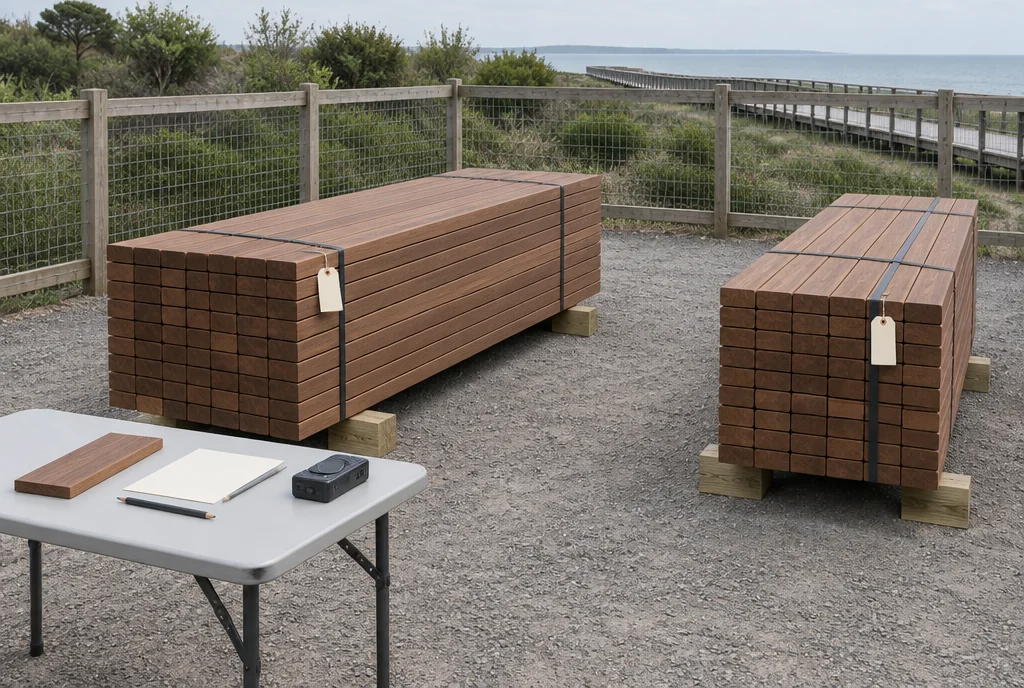
Concept example: one bundle carries a different profile code. Its location and label are recorded and the discrepancy is referred for resolution before installation.
Use the result
Keep the completed review with the relevant project record. Assign unresolved items before relying on a conclusion. If the material, condition or document changes, revisit the affected questions.
Boardwalk plannerTechnical references
General background for the subject. Project worksheets and fictional situations are original review aids, not official agency forms.
Access Board: floor and ground surfaces