01 / REVIEW
Divide the work
Map replacement segments, access points and storage locations. Record where the public route intersects proposed work areas. Do not assume a closure can be managed solely by a sign at one end.
02 / REVIEW
Assign temporary-access design
Ask the responsible project team to define approved temporary routes, barriers and communications. This planner estimates surface quantities only and does not design traffic control or accessible detours.
03 / REVIEW
Record reopening criteria
List the inspections and documents required before each segment reopens. Keep the decision owner visible and retain the release record with the segment identifier.
Plan the closed area as carefully as the new surface
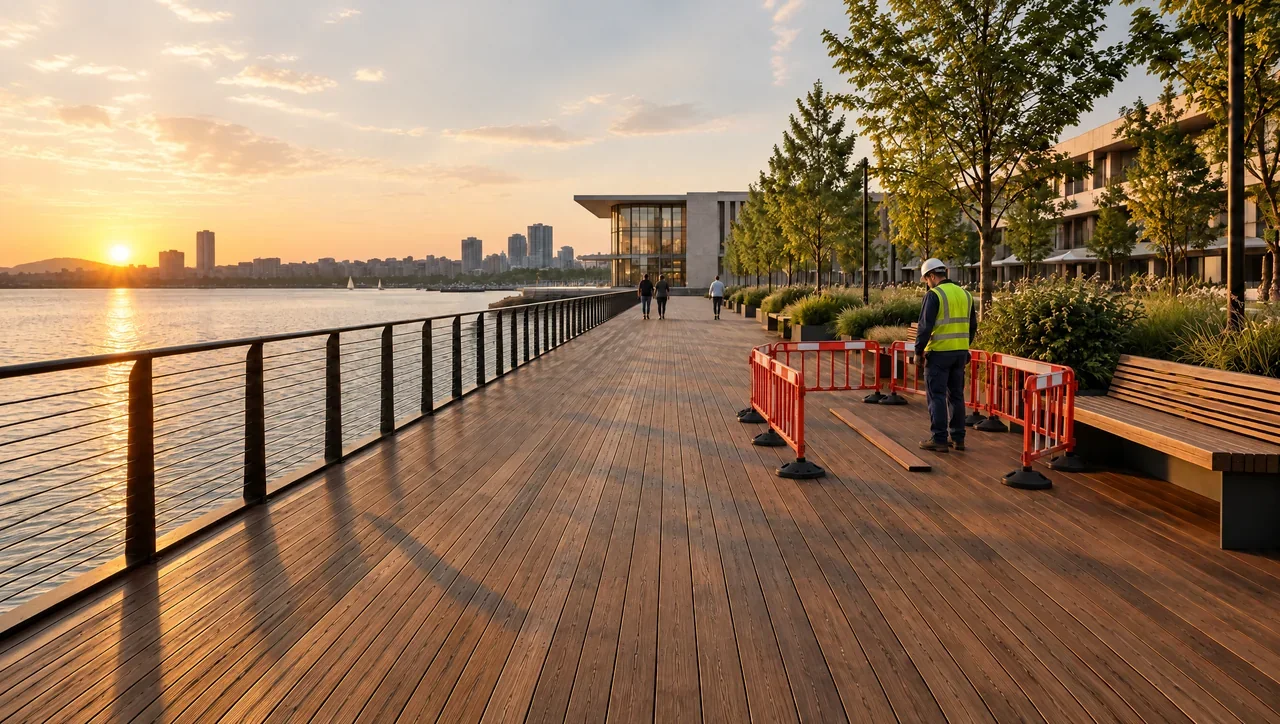
Replacement work affects the route while boards are absent. Establish the work limits, public separation, alternative access and the sequence for reopening. Where a route provides required access or emergency circulation, the responsible team must resolve those requirements before work begins.
Divide the work into sections that can be made complete and reviewable. A small daily work area is not automatically safer if it leaves many temporary edges or repeated transitions. Choose the sequence around the actual route, contractor access and operating constraints.
Separate known replacement from concealed discoveries
The visible surface quantity is only part of the scope. Removing boards may reveal support or connection conditions that need review. Set a process for documenting those findings, obtaining decisions and keeping the affected area closed until it is ready. Do not assume every exposed support can be reused merely because the contract began as a decking replacement.
Scroll sideways to read all columns. Keyboard: focus the table and use the arrow keys.
| Stage | Decision or record needed |
|---|---|
| Before closure | Work boundary, alternate route and communication responsibility |
| After removal | Exposed support condition and unresolved findings |
| Before new boards | Accepted detail, material identity and connection requirements |
| Before reopening | Completed edges, transitions, fixings and required inspections |
| After handover | Replacement locations, spare stock and future access notes |
Keep temporary works and structural decisions with the qualified parties responsible for them. This schedule organizes the surface replacement; it does not design a temporary bridge, barrier or support.
Order spares that can actually replace a board
Spare stock should match the specified section and intended replacement lengths. A collection of short offcuts is not equivalent to a stock of usable repair boards. Label the material, store it appropriately and record whether it is unfinished or already coated.
Check the removal sequence for concealed fastening. If replacing one field board requires releasing neighboring boards or accessing the underside, that affects labor, closure length and the spare components needed. Test the sequence in the mockup before assuming a simple per-board replacement operation.
At closeout, mark which sections were replaced and which supports or connections were retained. Keep the decisions behind those retained elements. The procurement evidence guide helps ensure the next maintenance team can identify the surface and its required parts without repeating the original selection process.
A public-route planning scenario
Concept example: a route has a single entry to a viewing area. Replacing the middle segment requires an approved access strategy; calculating the boards needed does not resolve that strategy.
Use the result
Keep the completed review with the relevant project record. Assign unresolved items before relying on a conclusion. If the material, condition or document changes, revisit the affected questions.
Boardwalk plannerTechnical references
General background for the subject. Project worksheets and fictional situations are original review aids, not official agency forms.
Access Board: floor and ground surfaces